
This page is based on the event record supplied by the Biolà team. Paper links point to the publisher or DOI record.
About this conversation
A special session on biomaterials, computational design, ecological thinking, and materials that actively respond to their environment.
We thank Jiaxin Wu for sharing the research, the thinking behind the discovery, and the challenges and decisions that shaped the work with the Biolà community.
PAPERS & REFERENCES
This interdisciplinary special issue did not cite a single featured paper in the source brief.
EVENT MATERIALS
Bioneer 06 Special Issue | Biodesign: Heterogeneous Biomaterials
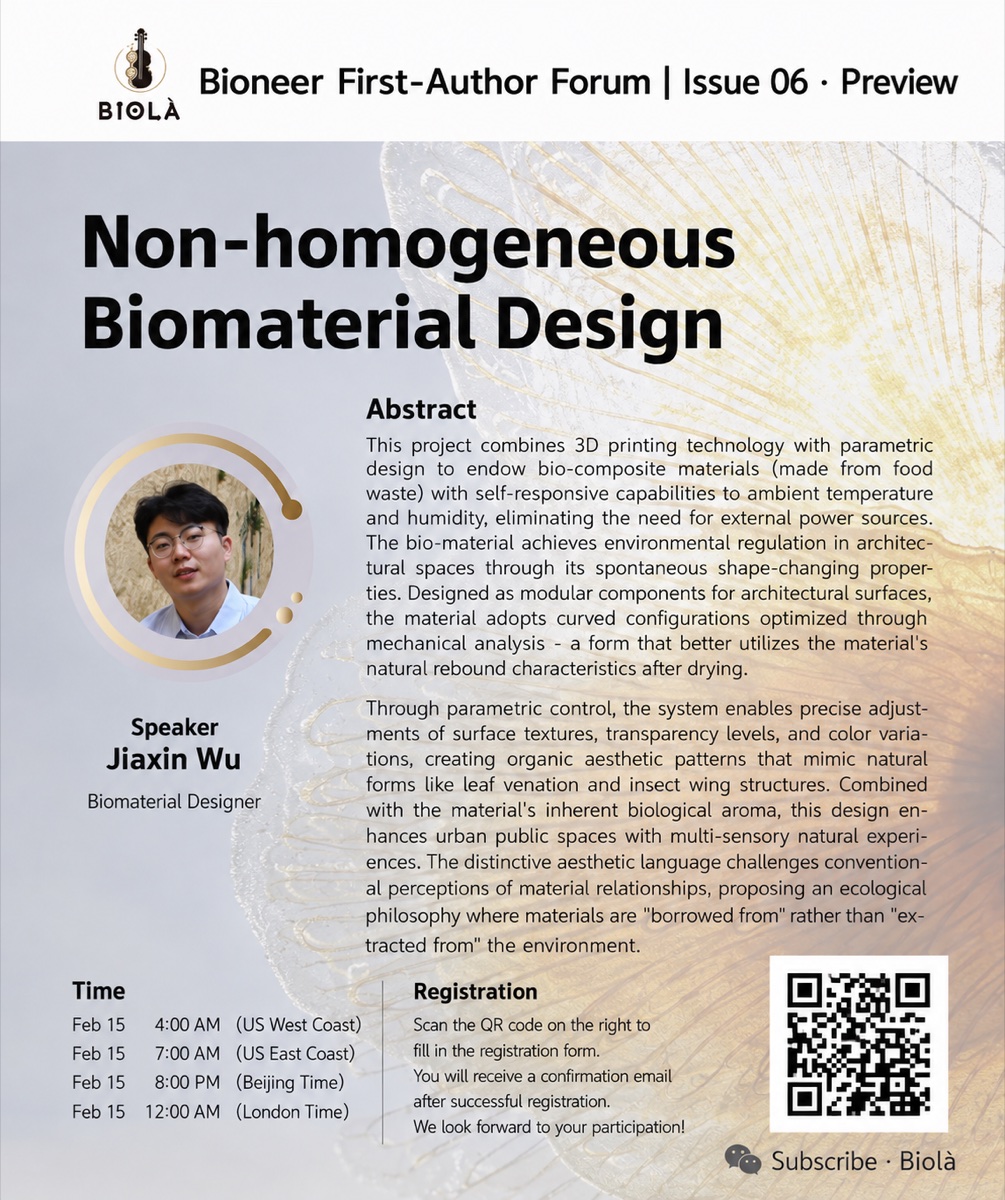
On February 15, 2025, at 8:00 PM Beijing Time, Biolà hosted a special issue of Bioneer, featuring Jiaxin Wu, a biomaterial designer and Visiting Lecturer at the Central Academy of Fine Arts (CAFA). Unlike the regular Bioneer First-Author Forum, this special session extended the series beyond scientific research to explore how biological materials can become a medium for design, experimentation, and new ways of thinking about our relationship with the environment.
Under the theme “Non-homogeneous Biomaterial Design,” Wu introduced a project combining 3D printing and parametric design with biocomposite materials made from food waste. The material was designed to respond autonomously to changes in ambient temperature and humidity through its intrinsic shape-changing properties, allowing modular architectural surfaces to contribute to environmental regulation without relying on external energy. Parametric control further enabled precise manipulation of surface texture, transparency, color, and curvature, producing forms inspired by structures such as leaf venation and insect wings.
Wu’s broader body of work also reflects this close attention to the relationship between material behavior, biological form, light, and environment. Representative works frequently employ translucent, wing- or leaf-like biomaterial elements arranged into larger installations, allowing repeated organic units to change visually as they interact with illumination, gravity, and surrounding space. These works provide a broader context for the design philosophy discussed in this session: rather than treating material simply as a passive substance to be shaped, Wu’s practice explores how the inherent properties of biological materials themselves can participate in the design process.
This approach also carries an ecological proposition. The project challenges conventional ideas of material production by considering materials as something “borrowed from” the natural environment rather than simply “extracted from” it, connecting material experimentation with questions of regeneration, sustainability, and multisensory experience.
We sincerely thank Jiaxin Wu for sharing this distinctive perspective with the Biolà community and for introducing how biomaterials, computational design, and ecological thinking can intersect within contemporary design practice.