This page is based on the event record supplied by the Biolà team. Paper links point to the publisher or DOI record.
About this conversation
Two complementary studies reveal how corticothalamic communication and proprioceptive feedback help distributed motor circuits coordinate skilled action.
We thank Dr. Yi Li for sharing the research, the thinking behind the discovery, and the challenges and decisions that shaped the work with the Biolà community.
EVENT MATERIALS
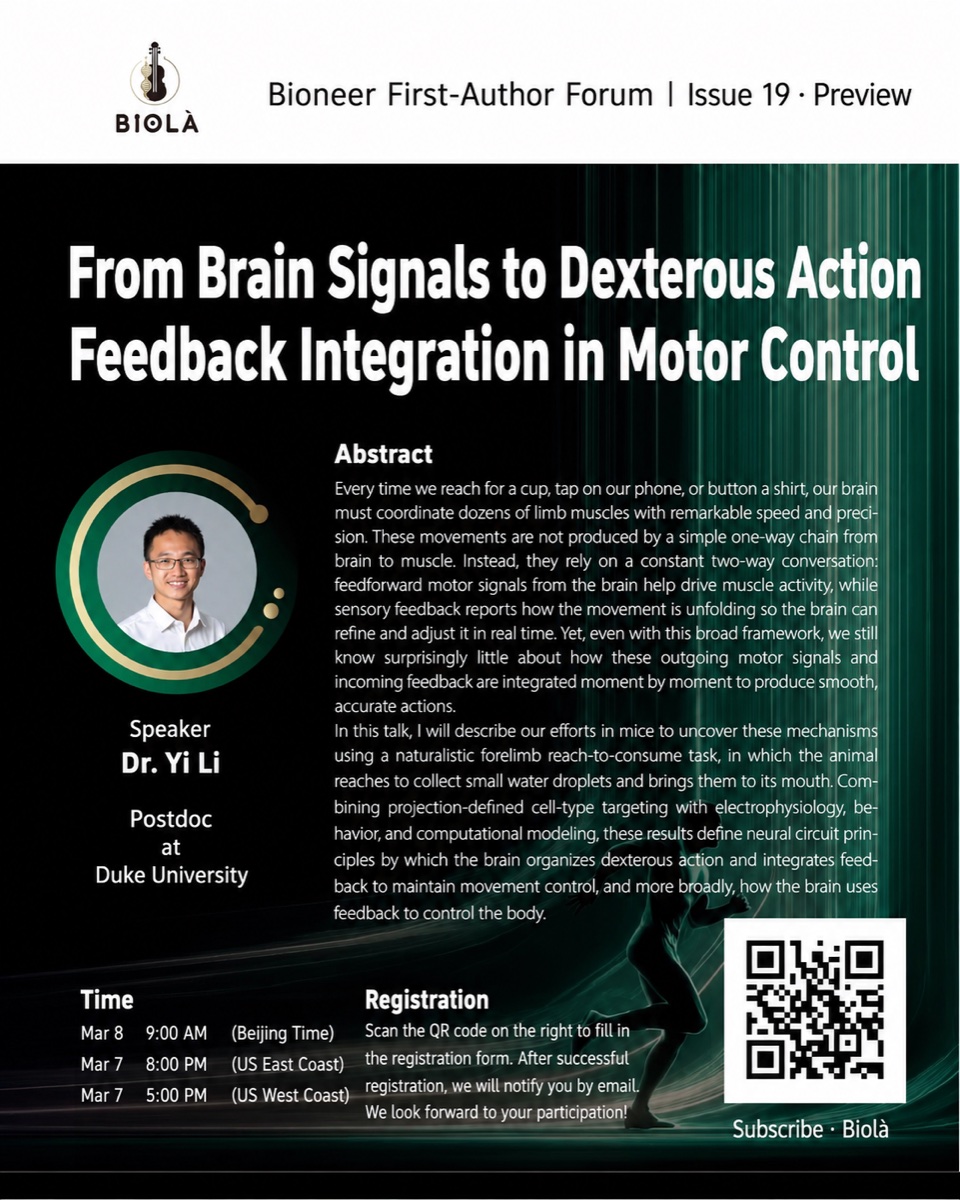
On March 8, 2026, from 9:00 to 10:30 AM Beijing Time, Biolà hosted the 19th issue of the Bioneer First-Author Forum, featuring Dr. Yi Li, a postdoctoral researcher at Duke University. Under the talk title “From Brain Signals to Skilled Action: Moving with Feedback,” Dr. Li drew on two first-author studies to discuss how distributed motor circuits coordinate skilled actions and how sensory feedback is integrated with descending motor commands during ongoing movement.
Skilled movements depend on a continuous interaction between feedforward motor commands and sensory feedback. Using a naturalistic forelimb reach-to-consume task in mice, together with projection-defined cell-type targeting, electrophysiology, behavioral analysis, and computational modeling, Li and colleagues investigated how this interaction is implemented across sensorimotor circuits. One line of work revealed how corticothalamic communication supports the progression and coordination of actions within a skilled motor sequence, highlighting the role of distributed cortical–thalamic interactions in organizing dexterous behavior.
A complementary study examined how proprioceptive feedback from muscles interacts with descending cortical activity during movement. By experimentally distorting proprioceptive input, the authors showed that feedback reshapes the geometry of ongoing motor cortical dynamics, allowing rapid adjustments in both muscle activation and ascending somatosensory signals. Together, these studies provide a circuit-level framework for understanding how the brain continuously integrates motor output with information about the body’s evolving state to maintain precise and adaptable movement.
We sincerely thank Dr. Yi Li for sharing these complementary lines of research with the Biolà community and for discussing how cortical, thalamic, and proprioceptive signals are integrated to transform neural activity into coordinated skilled action.
Citations:
Li, Y., Xu, X. H., Pan, S., An, X., Mulcahey, P. J., Qiu, Z., Zhao, S., Li, N., Pearson, J., & Huang, Z. J. (2025). Motor cortical output integrates distorted proprioceptive feedback. bioRxiv. https://doi.org/10.1101/2025.11.11.687832
Li, Y., An, X., Mulcahey, P. J., Qian, Y., Xu, X. H., Zhao, S., … Brunel, N., Whishaw, I. Q., & Huang, Z. J. (2026). Corticothalamic communication for action coordination in a skilled motor behavior. Nature Neuroscience. https://doi.org/10.1038/s41593-025-02195-8