
This page is based on the event record supplied by the Biolà team. Paper links point to the publisher or DOI record.
About this conversation
The study maps communication between enteric neurons and sensory afferents and shows how inflammation can transform a non-aversive pathway into a persistent pain pathway.
We thank Dr. Zhuang Wang for sharing the research, the thinking behind the discovery, and the challenges and decisions that shaped the work with the Biolà community.
PAPERS & REFERENCES
NeuronEVENT MATERIALS
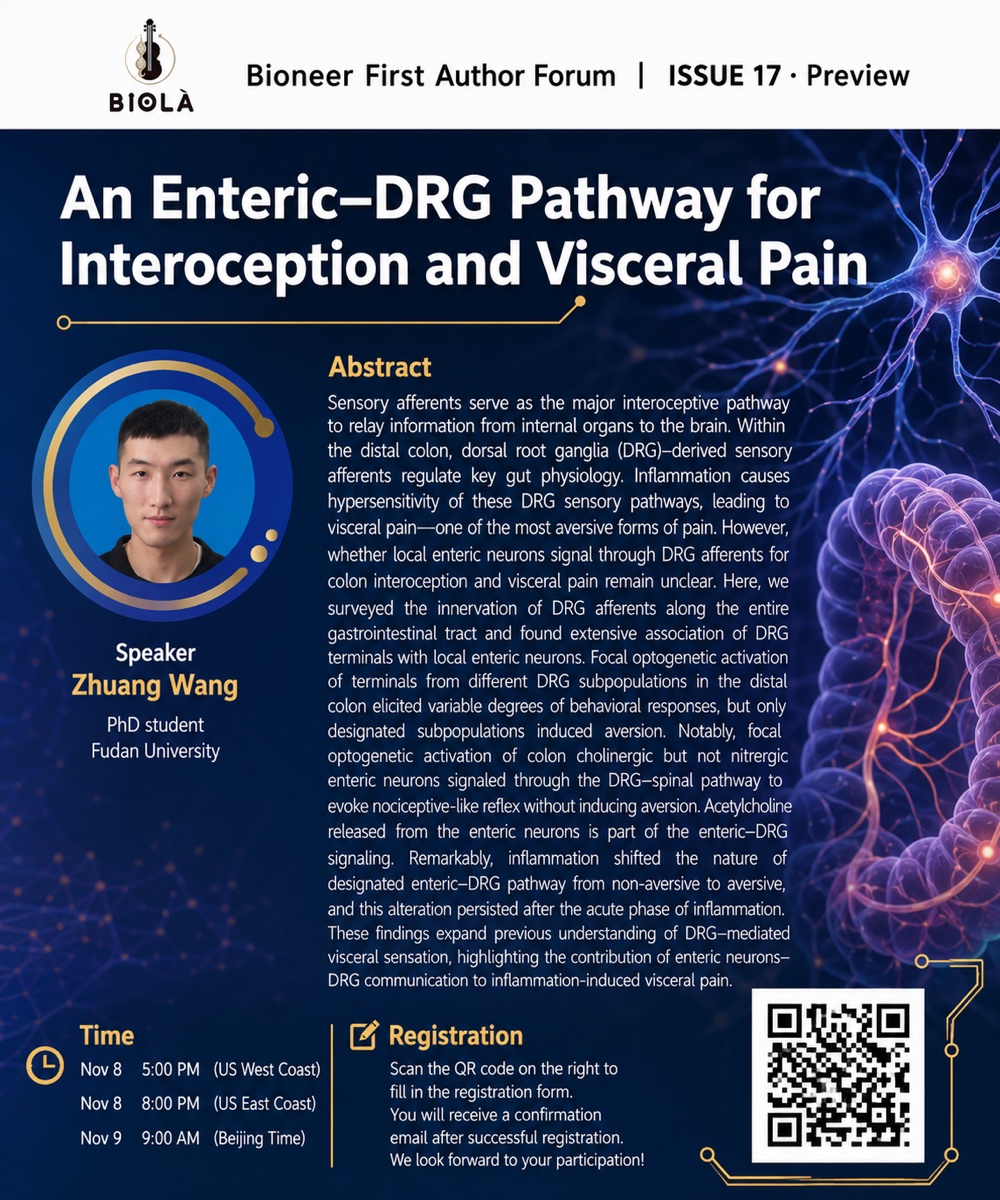
On November 9, 2025, from 9:00 to 10:30 AM Beijing Time, Biolà hosted the 17th issue of the Bioneer First-Author Forum, featuring Dr. Zhuang Wang, who received his PhD in Neurobiology from Fudan University. The session was delivered in Chinese. Under the talk title “An Enteric–DRG Pathway for Interoception and Visceral Pain,” Dr. Wang introduced his first-author study “An Enteric-DRG Pathway for Interoception and Visceral Pain in Mice,” published in Neuron in 2025.
Sensory afferents arising from the dorsal root ganglia (DRG) provide a major route through which information from internal organs reaches the central nervous system. Wang and colleagues mapped DRG innervation throughout the gastrointestinal tract and found extensive associations between DRG terminals and local enteric neurons. In the distal colon, optogenetic activation of different DRG subpopulations produced distinct behavioral responses, with only specific populations generating aversive responses.
The study further identified a functional pathway linking cholinergic enteric neurons to DRG sensory afferents and the spinal cord. Activating these enteric neurons evoked nociceptive-like reflexes without producing aversion, with acetylcholine contributing to enteric–DRG communication. Strikingly, inflammation transformed a normally non-aversive enteric–DRG pathway into an aversive one, and this change persisted beyond the acute inflammatory phase. These findings reveal how communication between the enteric nervous system and peripheral sensory neurons can be reshaped by inflammation to contribute to persistent visceral pain.
We sincerely thank Dr. Zhuang Wang for sharing the findings and scientific thinking behind this work with the Biolà community, and for discussing how enteric and sensory neural circuits jointly shape interoception and visceral pain.
Citation: Wang, Z., Tang, Q., Li, K., Mou, J., Chen, Y., Kuang, W., Sun, L., Ma, Z., Wei, Y., Bao, R., Sun, X., Wang, S., Lu, W., Xu, G.-Y., Tang, Y.-Q., Duan, S., & Ni, J. D. (2025). An enteric-DRG pathway for interoception and visceral pain in mice. Neuron, 0(0). https://doi.org/10.1016/j.neuron.2025.09.035