
This page is based on the event record supplied by the Biolà team. Paper links point to the publisher or DOI record.
About this conversation
gsMap combines spatial transcriptomics with GWAS data to identify trait-associated cells while preserving their position within tissues.
We thank Liyang Song for sharing the research, the thinking behind the discovery, and the challenges and decisions that shaped the work with the Biolà community.
PAPERS & REFERENCES
NatureEVENT MATERIALS
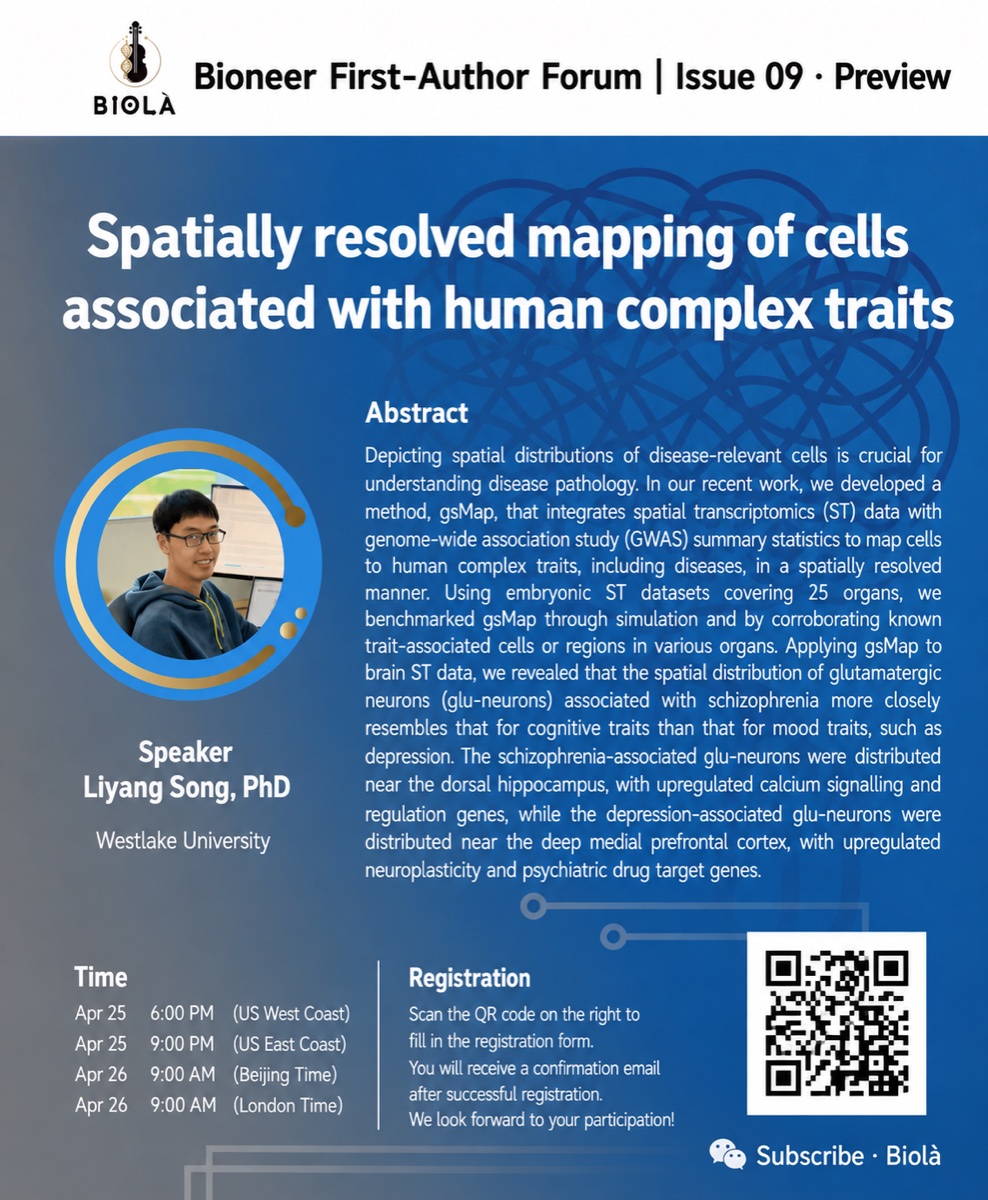
On April 26, 2025, at 9:00 AM Beijing Time, Biolà hosted the 9th issue of the Bioneer First-Author Forum, featuring Liyang Song, a PhD student in Statistical Genetics at Westlake University, advised by Professor Jian Yang. Under the theme “Spatially Resolved Mapping of Cells Associated with Human Complex Traits,” Song introduced his first-author study of the same title, published in Nature in 2025.
Understanding where disease-relevant cells are located within tissues is essential for connecting genetic associations to biological mechanisms. Song and colleagues developed gsMap, a computational framework that integrates spatial transcriptomics with genome-wide association study (GWAS) summary statistics to identify cells associated with human complex traits while preserving their spatial organization. Using embryonic spatial transcriptomic datasets spanning 25 organs, the authors validated the method through simulations and by recovering previously known trait-associated cell populations and anatomical regions.
Applying gsMap to the brain revealed distinct spatial patterns among neurons associated with psychiatric and cognitive traits. Schizophrenia-associated glutamatergic neurons were preferentially distributed near the dorsal hippocampus and showed enrichment of genes involved in calcium signaling and its regulation, whereas depression-associated glutamatergic neurons were concentrated near the deep medial prefrontal cortex and exhibited increased expression of genes related to neuroplasticity and psychiatric drug targets. More broadly, the spatial pattern associated with schizophrenia showed greater similarity to cognitive traits than to mood-related traits, illustrating how spatially resolved genetic mapping can help distinguish the cellular organization underlying different complex phenotypes.
We sincerely thank Liyang Song for sharing the development of gsMap and the scientific thinking behind this work with the Biolà community, and for discussing how human genetics, statistical methodology, and spatial omics can be integrated to study complex disease biology.
Citation: Song, L., Chen, W., Hou, J., Guo, M., & Yang, J. (2025). Spatially resolved mapping of cells associated with human complex traits. Nature. https://doi.org/10.1038/s41586-025-08757-x