
This page is based on the event record supplied by the Biolà team. Paper links point to the publisher or DOI record.
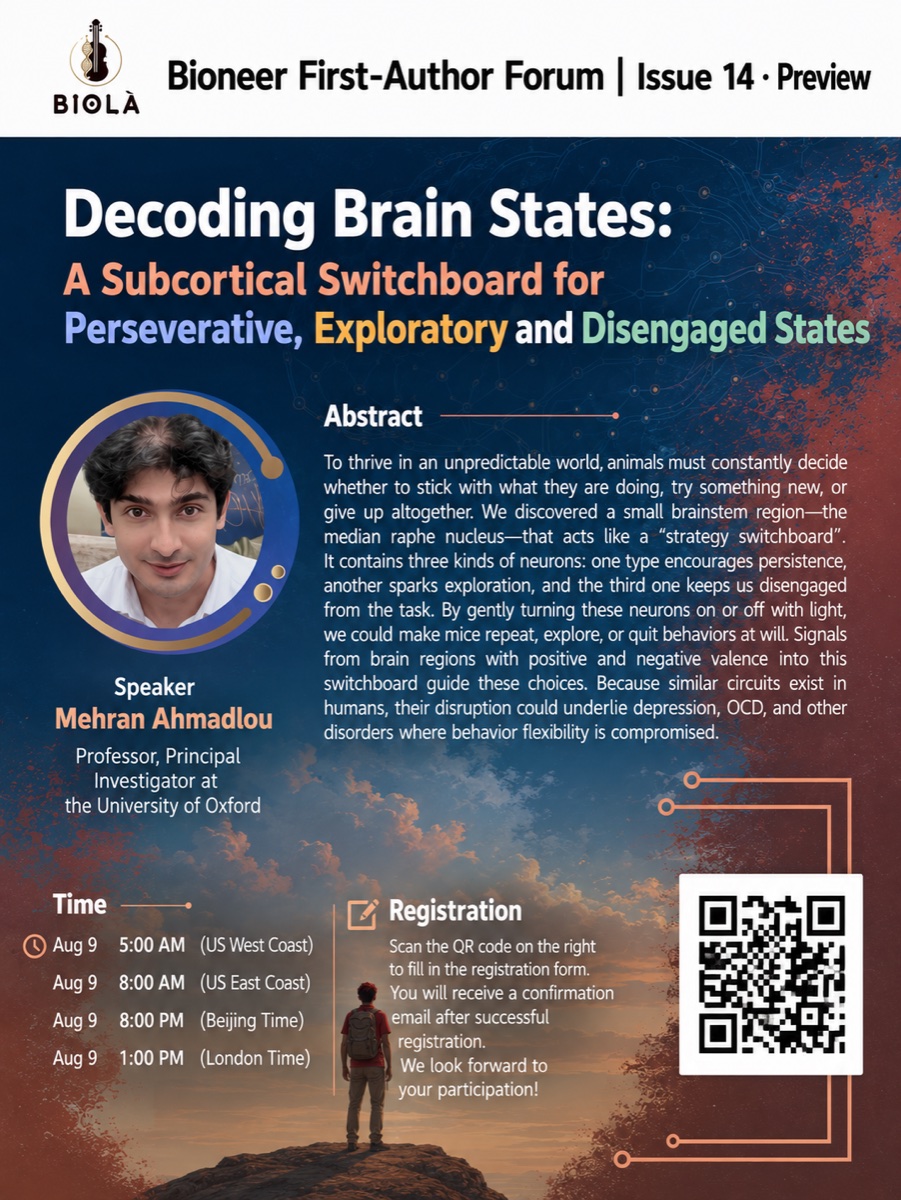
About this conversation
The median raphe nucleus acts as a compact hub that helps animals switch among persistence, exploration, and disengagement.
We thank Prof. Mehran Ahmadlou for sharing the research, the thinking behind the discovery, and the challenges and decisions that shaped the work with the Biolà community.
PAPERS & REFERENCES
NatureEVENT MATERIALS
On August 9, 2025, at 8:00 PM Beijing Time, Biolà hosted the 14th issue of the Bioneer First-Author Forum, featuring Professor Mehran Ahmadlou, Principal Investigator at the University of Oxford. Professor Ahmadlou studies how cortical and subcortical neural circuits integrate internal states, external stimuli, past experience, and competing motivations to shape behavioral strategies and decision-making. As the first author of the featured study, he presented “A Subcortical Switchboard for Perseverative, Exploratory and Disengaged States,” published in Nature in 2025.
Adaptive behavior requires animals to continually decide whether to persist with a current strategy, explore alternatives, or disengage altogether. Ahmadlou and colleagues identified the median raphe nucleus (MRN) as a subcortical hub that helps coordinate transitions among these three behavioral states. Within the MRN, distinct neuronal populations were associated with perseverative, exploratory, and disengaged behaviors, and optogenetic manipulation of these populations could selectively bias mice toward repeating, exploring, or abandoning behavioral choices.
The study further showed that inputs carrying positive and negative valence signals converge onto this circuit and help regulate behavioral-state switching. By revealing a compact neural architecture for balancing persistence, exploration, and disengagement, the work provides a circuit-level framework for understanding behavioral flexibility. Dysregulation of related mechanisms may also be relevant to psychiatric conditions in which adaptive switching between behavioral strategies is impaired.
We sincerely thank Professor Mehran Ahmadlou for sharing the discoveries and scientific thinking behind this work with the Biolà community, and for discussing how subcortical circuits dynamically regulate behavioral strategy and flexibility.
Citation: Ahmadlou, M., Shirazi, M. Y., Zhang, P., Rogers, I. L. M., Dziubek, J., Young, M., & Hofer, S. B. (2025). A subcortical switchboard for perseverative, exploratory and disengaged states. Nature, 641(8061), 151–161. https://doi.org/10.1038/s41586-025-08672-1